The US in Decline: Lessons for British Muslims
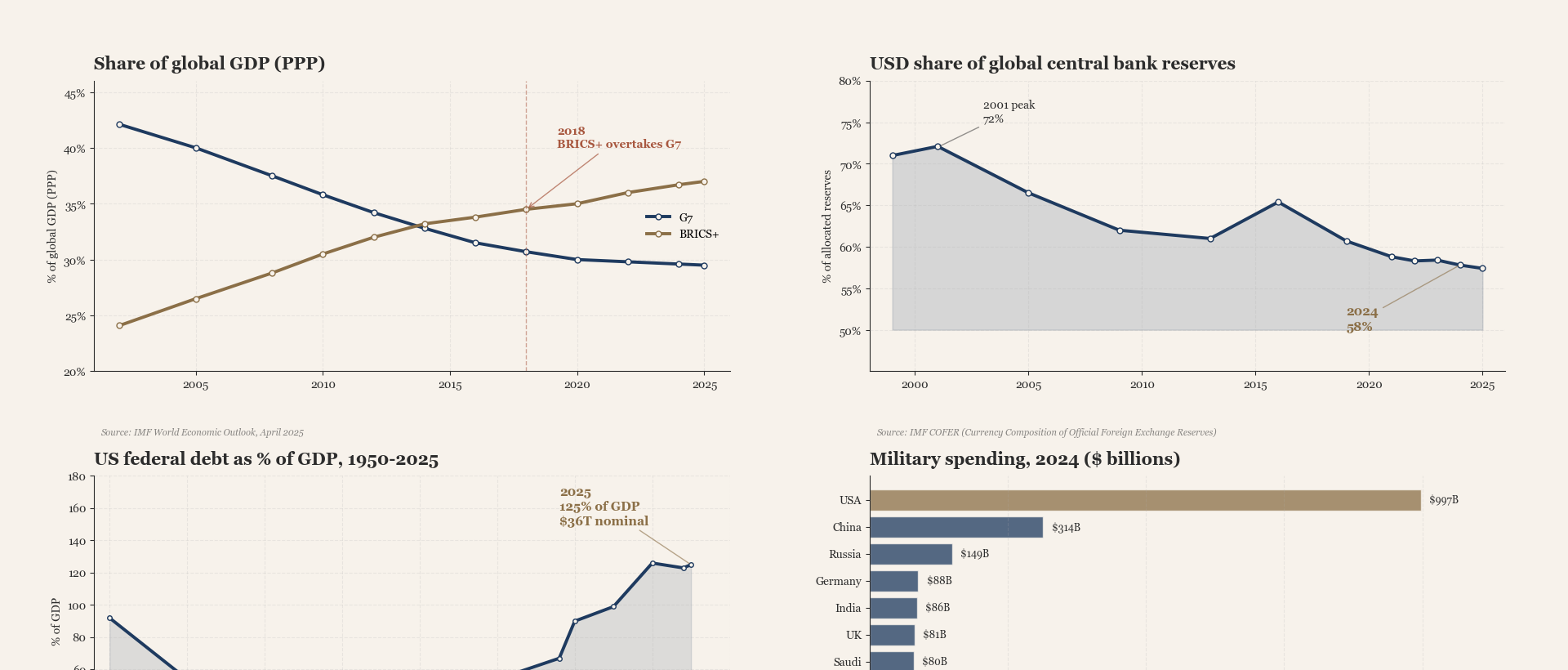
For decades, the United States has been the dominant power shaping the global order. Its military reach extended across continents, its corporations set the tone of global markets, and its currency --- the dollar --- underpinned the world's financial system. Britain, tied tightly to American influence through politics, trade, and security, has ridden on its coat-tails.
But the era of unchallenged US dominance is ending. The signs of decline are evident in economics, politics, and global standing. For British Muslims, understanding this shift is not academic. The UK's deep alignment with the United States means that America's decline translates directly into Britain's own fragility --- and therefore into the daily lives of Muslims living here.
Economic Stagnation and Fiscal Strain
The United States carries a national debt now exceeding \over $36 trillion, a figure that grows each year. Inflation and interest rate pressures undermine households and weaken consumer confidence. Entire industries, once synonymous with American innovation, are being challenged by rivals in Asia.
At the same time, inequality has widened. A hollowed-out middle class, declining manufacturing, and regional imbalances create internal weakness. While the US remains a wealthy country, its fiscal position increasingly rests on borrowed time. Britain, bound closely to American markets and dependent on the dollar system, cannot avoid absorbing these shocks.
Political Division and Erosion of Authority
Domestic politics in the United States is polarised to a degree unseen in generations. The two-party system is paralysed by hostility, with neither side able to command lasting consensus. Institutions once respected globally --- Congress, the Presidency, even the Supreme Court --- are mired in partisanship.
This internal weakness spills outward. Allies see inconsistency, while rivals see opportunity. The wars America has fought in recent decades, from Iraq to Afghanistan, not only drained resources but also eroded credibility. The claim to moral authority is undermined by hypocrisy: preaching democracy abroad while dysfunction grows at home.
The End of a Unipolar World
For 30 years after the Cold War, the US sat as the unchallenged superpower. That period has closed. The rise of China, the reassertion of Russia, and the consolidation of blocs like BRICS+ mark a new multipolar order. Power is no longer dictated by one centre. Trade routes, currencies, and alliances are diversifying.
For Muslim lands, this shift matters deeply. Energy-rich countries in the Gulf, strategic hubs like Turkey, and emerging economies such as Indonesia are asserting greater independence. They are less willing to operate solely under American terms and more able to engage with new partners. Opportunities are emerging for Muslim-majority nations to shape their own futures rather than serve as extensions of Western interests.
Britain's Inheritance of Decline
Britain is not the United States, but its fortunes are bound tightly to Washington. Economically, the pound follows the dollar's movements. Politically, foreign policy aligns instinctively with American interests. Militarily, the "special relationship" remains central.
As the US weakens, Britain loses with it. Declining leverage in trade negotiations, reduced credibility abroad, and domestic strains mirror those of its ally. For Muslims in Britain, this inheritance of decline means greater economic pressures, sharper political rhetoric, and fewer opportunities for stability.
Lessons for Muslims in Britain
The lessons are clear:
- Decline is real and long-term. The US will not collapse overnight,
but the trajectory is downward. For Britain, tied so closely to America, the same holds true.
- Minorities bear the weight. History shows that declining powers
turn inward, and minorities become scapegoats. Muslims in Britain must expect greater pressure as economic and political challenges deepen.
- Opportunities lie elsewhere. As power disperses into a multipolar
order, Muslim-majority countries gain space to grow. Energy producers, youthful populations, and new trade links create real alternatives to Western dependency.
Islamic Anchoring
Islam reminds us of the impermanence of worldly power. "Do they not travel through the land and see what was the end of those before them? They were stronger than them in power, and they cultivated the earth and populated it more than they do" (30:9). Empires rise and fall; strength today is no guarantee of tomorrow. For Muslims, this is not cause for despair but for perspective. Our loyalty lies not with fading powers but with Allah and the global Ummah.
The Role of Foresight
For Muslims in Britain, the decline of US dominance is not just background noise. It is a call to foresight. Anchoring our entire future in systems tied to America's fortunes is risky. Exploring alternatives --- whether through economic diversification, building ties with Muslim-majority countries, or considering relocation in stages --- is sensible preparation.
The second home strategy, modest but practical, embodies this foresight. It gives families options outside Britain's orbit, linking them to societies less tied to American decline and more integrated into the rising multipolar world.
Conclusion
The United States is in decline, and the age of a single global superpower is over. A multipolar world is emerging, one in which Muslim nations have the chance to assert greater independence and influence. Britain, locked into America's orbit, will not escape the consequences.
For British Muslims, the lesson is to prepare. Economic fragility, political hostility, and cultural pressure will intensify here. The alternative is not retreat but foresight: reconnecting with the global Ummah, exploring opportunities in Muslim-majority lands, and building bridges that protect faith and family in uncertain times.
Empires rise, empires fall. Our duty is to ensure that our loyalty, our preparation, and our future are anchored where they truly belong.
Next Step: American decline is directly connected to British fragility — and to the opportunities opening in Muslim-majority countries as the multipolar world takes shape. [BRICS+ and the End of Western Dominance](../article/brics-and-the-end-of-western-dominance) gives the full picture of what is replacing the old order.