Europe's Ageing Crisis: What It Means for Muslim Families
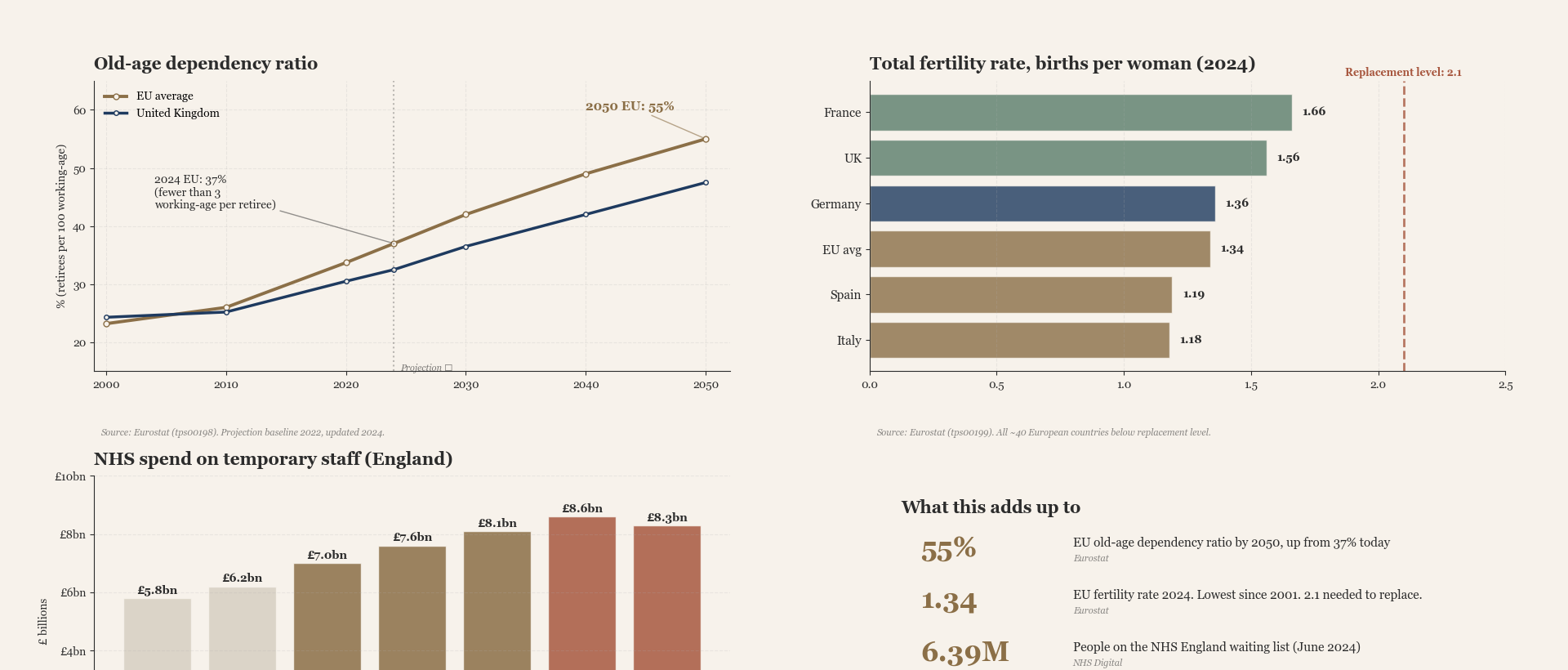
Walk into almost any British hospital ward, and you see the reality of an ageing population. Elderly patients outnumber younger ones, corridors are crowded, and staff shortages are routine. The NHS, once a source of national pride, now struggles under the weight of demand. For Muslim families, these problems are not abstract statistics. They shape the environment in which we live, work, and raise our children.
Europe as a whole is ageing rapidly. Birth rates have been below replacement level for decades. Populations are shrinking, and with them, the base of taxpayers needed to fund public services. At the same time, life expectancy has increased, creating more years of pension payments, healthcare costs, and dependency. This is not a passing problem. It is structural, deep, and irreversible. And Britain, as part of Europe, is not immune.
What the Numbers Say
In 1970, Britain had roughly four working-age adults for every retiree. By 2020, that ratio had fallen to three to one. By 2050, it is expected to be closer to two to one. Germany, Italy, and Spain face even worse ratios. With fewer young workers and more elderly citizens, governments are caught in a bind: raise taxes, cut services, or borrow unsustainably.
For Muslim families in the UK, this means higher tax burdens, longer waiting lists, and fewer resources available for schools, housing, and infrastructure. Already, we see pension reforms that push retirement ages higher, childcare costs that remain stubbornly high, and NHS delays measured in months rather than weeks. The future will bring more of the same.
Why This Matters for Muslims
Muslims in Britain are a younger population on average. Our families still have higher birth rates, and our communities are more youthful. On paper, this looks like an advantage: more workers, more vibrancy, more growth. But in practice, it often means our taxes and labour subsidise a system designed to care for an ageing non-Muslim majority.
There is also a cultural layer. An ageing Europe often looks backward. Political debates focus on nostalgia, protectionism, and defending "traditional" (meaning European, not Islamic) identities. In times of strain, minorities become convenient scapegoats. Already, we see rising hostility in political rhetoric. When systems come under pressure, our communities are often accused of draining resources. When pensions run short, immigration is blamed.
For families trying to raise children with confidence, this atmosphere creates an additional layer of fitnah: not only the moral pressures of Western culture, but also the social pressures of being cast as outsiders in a declining system.
The Intergenerational Burden
The crisis is not just about numbers; it is about relationships between generations. In Britain, young workers already struggle to afford homes while also supporting elderly parents and grandparents through taxes. For Muslim families, this pressure is doubled. We care for our elders within the household --- which is part of our deen and a source of blessing --- but we also carry the burden of a national system that demands more and more from the young to fund the old.
This creates financial strain. Mortgages, student loans, childcare fees, and rising taxes combine into a heavy load. Families ask themselves how to build savings, how to pay zakat, and how to provide for the future when every month feels stretched. For some, the idea of Hijrah becomes not just spiritual foresight, but financial survival.
Islamic Framing
Islam does not dismiss the elderly. Quite the opposite: "He is not of us who does not show mercy to our young and honour to our old" (Tirmidhi). Caring for elders is part of faith. But there is a difference between honouring parents and grandparents, and being locked into a national system that treats Muslim families as a workforce to prop up an unsustainable model.
The Qur'an reminds us: "Indeed, Allah will not change the condition of a people until they change what is in themselves" (13:11). Europe cannot escape demographic decline without radically changing its culture, and there is little sign that will happen. The reality for Muslims is that we are being tied to a ship that is slowly sinking.
A Case Study: The Patel Family in Manchester
The Patels are a three-generation household. The grandparents live with them, the parents both work, and the children are in school. Every month, the family budget is stretched thin. Taxes take a large share of income, student loans are deducted automatically, and the cost of living rises steadily.
Despite this, they find barakah in looking after their elders. But they also see the pressure around them: neighbours waiting a year for NHS treatment, friends unable to buy homes, colleagues worrying about pensions. The Patels decided to invest in a small flat in Kuala Lumpur. They don't plan to move full-time yet, but they use it for extended family visits. Their children experience life in a society where Islam is normal, and the family has a foothold if conditions in Britain worsen.
The Patels' decision doesn't solve Britain's problems, but it gives them a measure of independence from a system that is heading for deeper crisis.
The Second Home Bridge
This is where the concept of a second home abroad becomes practical. Families do not have to leap overnight. By creating a modest base in a Muslim country, they gain:
- An alternative healthcare system, often more affordable than the NHS.
- A cultural environment where ageing is supported by family and
community rather than overstretched bureaucracy.
- A foothold for children to experience normalised Islam.
- A financial hedge against Britain's tax-heavy, debt-laden system.
It is not about running away from responsibilities in Britain. It is about building resilience. Just as zakat diversifies wealth spiritually, a second home diversifies family stability physically and financially.
Britain's Decline Is Structural
The important point is this: ageing populations cannot be reversed quickly. Even if Britain encouraged higher birth rates tomorrow, it would take a generation to balance the ratio. Immigration has kept the system afloat, but it also fuels political backlash. The trajectory is set: more elderly, fewer young, heavier burdens on families like ours.
For Muslims, this means recognising that the environment around us is not just morally challenging, but economically unsustainable. We cannot allow ourselves to be so entangled that when the system strains further, we collapse with it.
Conclusion: Foresight Over Complacency
Europe's ageing crisis is not an academic debate. It is the reality that shapes the taxes we pay, the services we rely on, and the atmosphere in which our children grow. For Muslim families in Britain, it carries an additional weight: we are younger, more vibrant, and more committed to family --- but this makes us both valuable and vulnerable in a system under pressure.
The prophetic response to pressure was foresight. When Makkah became unbearable, the Muslims did not simply hope for the best. They made Hijrah. For us, that does not have to mean an overnight move. It can mean deliberate steps: strengthening our families here, building community, and creating bridges abroad.
Safeguarding our deen means not only protecting against cultural erosion, but also against economic and social decline. Europe's trajectory is clear. The question is whether we plan now, or wait until the system forces our hand.
Next Step: Understanding the structural pressures is the first step. For a practical look at what families are doing to build resilience, read [The Second Home Strategy](../article/the-second-home-strategy) and [Cost of Living: UK vs Turkey vs Malaysia](../article/cost-of-living-uk-vs-turkey-vs-malaysia).