Dubai for Muslim Families: A Clear Look at What It Offers, and What It Asks
Navigating the Emirates' business ecosystem for economic independence
A grounded, practical guide for families considering Dubai as a second base or future home.
When Muslim families in the West begin exploring Muslim-majority countries, Dubai often enters the conversation early. It is close enough in language, infrastructure, and schooling to feel familiar. It is far enough from Western social pressures to feel like a change.
But the conversation often stops at "Dubai is Muslim-friendly" or "Dubai is tax-efficient."
Those statements are true. They are also incomplete.
This is a closer look. What Dubai actually offers a Muslim family. What it asks of you in return. And who it suits, honestly.
What Dubai actually offers
Dubai has grown in a few decades from a modest Gulf port into one of the most connected cities in the world. For a Muslim family, that connectivity matters. You can fly to London in seven hours, Karachi in three, Istanbul in four. It sits on a crossroads by design.
The Islamic rhythm of the city is real. The adhan is audible across neighbourhoods. Halal food is the default, not a search. Fridays move around Jumu'ah. Ramadan changes the pace of the whole city. These things are small until you have lived without them, and then you understand how much texture they give to family life.
The business environment is credible. Free zones allow 100% foreign ownership and are relatively simple to set up. Mainland structures give full market access with more compliance. The 9% corporate tax introduced in 2023 changed the calculation somewhat, but Dubai remains among the more competitive jurisdictions globally, especially for service businesses, trading companies, and knowledge-economy work.
English is the working language. Professional networks are large and constantly refreshed. The infrastructure, airports, ports, digital, banking, functions at a high standard.
What Dubai asks of you
There are trade-offs, and they deserve an honest account.
The cost of living is high. Schools, housing, healthcare, cars. Each item costs more than most families assume when they arrive. Family budgets that work comfortably in the UK often feel tight in Dubai in the first year. Plan for a longer runway than you think.
The pace is fast. Dubai rewards ambition and productivity. It can also exhaust those who need slower, quieter living. Consider how your family thrives before you assume you will adapt.
Culturally, Dubai is plural. You will find deeply practising Muslim communities, and you will also find a highly consumerist, nightlife-facing layer that sits alongside them. Neither is hidden. Families make choices about neighbourhood, school, and social circle, just as they would anywhere, and those choices shape the experience.
Residency is tied to employment, investment, or business ownership. It is not automatic, and it requires active maintenance. Property ownership rules differ from the UK and deserve careful understanding before any commitment.
Summer is extreme. From June to September, life moves indoors. Families typically spend part of the summer elsewhere.
Who Dubai suits
Dubai tends to work well for:
- Service-business owners and senior professionals who can work globally and want a tax-efficient, well-connected base
- Families with school-age children who value a Muslim-majority environment with English-medium schooling
- Entrepreneurs serving markets across the Gulf, South Asia, and East Africa from a single hub
Dubai tends to be harder for:
- Families looking for a quieter, slower pace and deeper cultural rootedness
- Early-career professionals without a clear income path, where margins are thin
- Those hoping for the simplicity of a small Muslim town. Dubai is not that.
Neither list is final. Families adjust, expectations change, and the right answer for year one is not always the right answer for year five.
Practical first steps
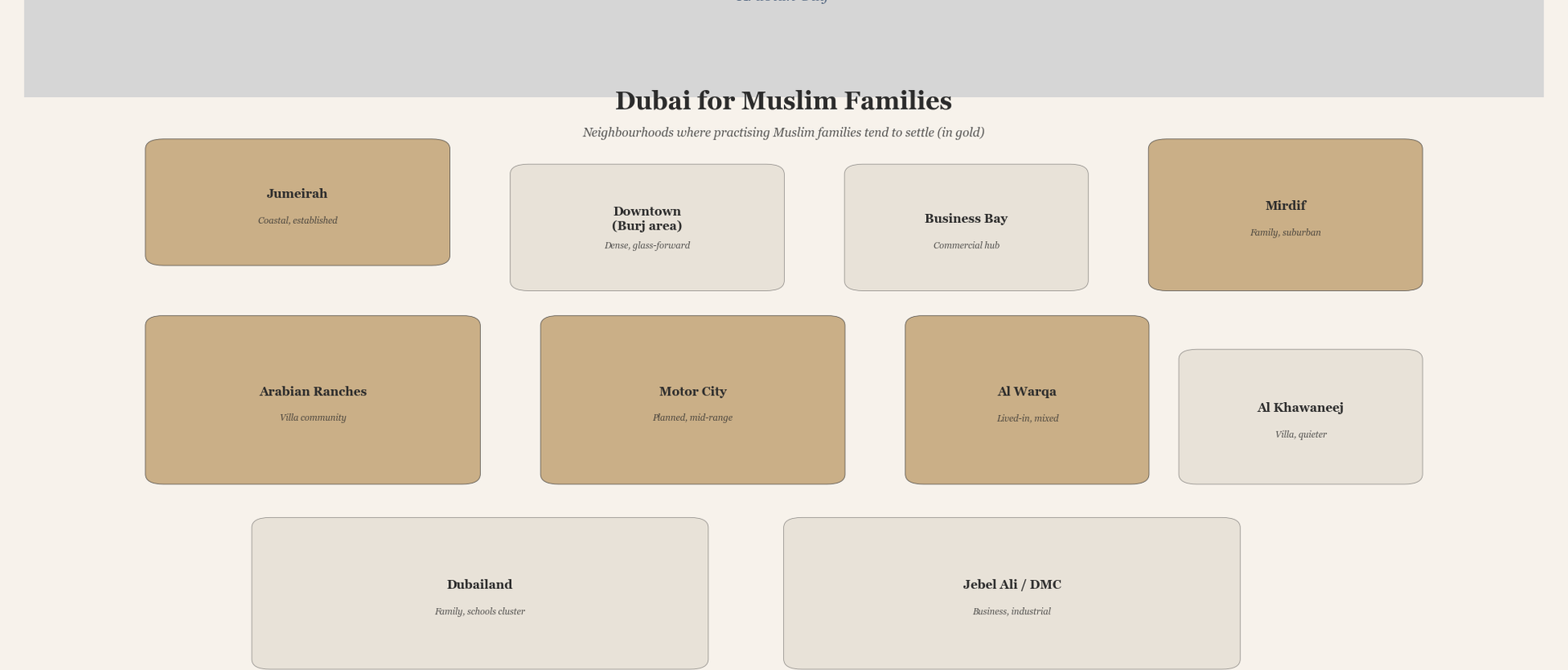
Before any commitment, visit in depth. Not a week. Two to three weeks, across two trips, in different seasons. Spend time in neighbourhoods where Muslim families live, Jumeirah, Mirdif, Arabian Ranches, Motor City, parts of Al Warqa. Visit schools. Sit in a café near the masjid. Ask other families what they wish they had known in year one.
Understand the residency options in detail, employment visa, investor visa, Golden Visa, business setup routes. Each comes with different time horizons, costs, and commitments.
Talk to a tax adviser who understands both UK and UAE frameworks. Leaving the UK tax net is not automatic and gets costly if mishandled.
Look at Dubai as one option among several, Istanbul, Kuala Lumpur, Doha, Riyadh, Sharjah, not as an only answer. Clarity comes from comparison.
A longer view
A move to Dubai, or anywhere else, is a significant decision. It touches your family's rhythm, your children's formation, your community, and your faith life. It deserves the time a decision of that weight earns.
If Dubai is the right fit, it can offer a Muslim family a genuinely different environment to build in, one where Islam is the default rather than the exception. If it is not, the question is still valuable. Thinking carefully about where your family will thrive is itself an act of foresight.
Either way, the question is worth asking.