China's Rise: Opportunity or Threat for the Ummah?
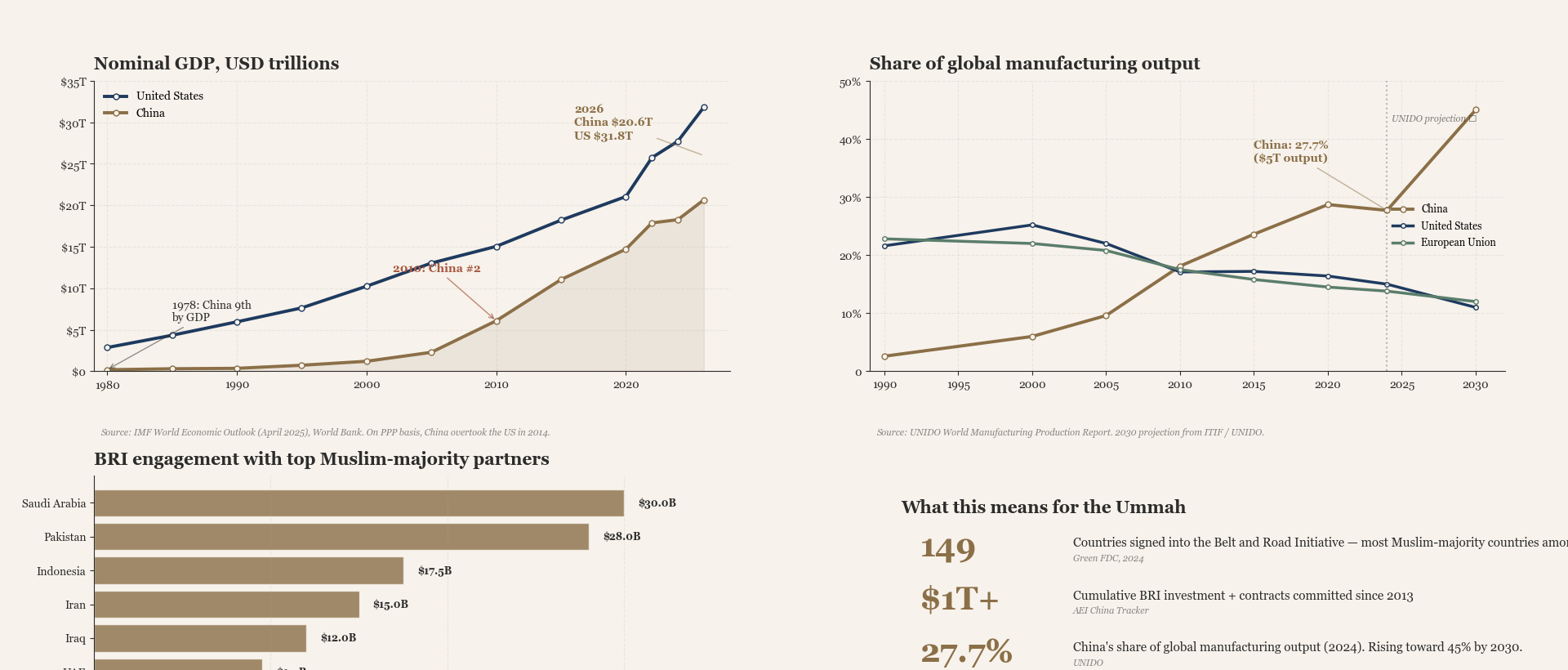
For much of the last century, the global order was dominated by a single axis of power: the United States and its Western allies. That order is shifting. China has emerged as the foremost challenger to American dominance, reshaping trade, technology, finance, and geopolitics. Its rise is one of the defining facts of our age, and its implications stretch far beyond Asia.
For Muslims, the question is complex. China presents opportunities for Muslim-majority countries to diversify their partnerships, resist Western dependency, and benefit from new economic links. At the same time, its authoritarian system, surveillance model, and policies in Xinjiang cast a long shadow. For British Muslims, caught in a Britain tied to American decline, China's rise must be assessed with clarity: where are the opportunities, where are the dangers, and how should foresight shape our choices?
The Scale of China's Rise
China's growth has been staggering. In the 1980s, its economy was smaller than Italy's. Today, it is the world's second-largest economy and is projected by many analysts to surpass the United States in overall GDP within the next decade. It has become the world's factory, the hub of global supply chains, and a leader in areas like 5G, AI, and green technology.
China has also become the largest trading partner for over 120 countries, including many in the Muslim world. Its Belt and Road Initiative (BRI) stretches across Asia, Africa, and the Middle East, building ports, railways, and energy infrastructure. For Gulf states, Turkey, and North Africa, Chinese investment has become a key driver of development.
This rise is not just economic. Militarily, China is modernising at speed, expanding its navy and projecting influence in the South China Sea and beyond. Diplomatically, it is increasingly visible in conflict mediation --- including facilitating the 2023 diplomatic reset between Saudi Arabia and Iran, a rapprochement that Washington had little interest in pursuing because its entire strategy was to keep them apart ([Reuters](https://www.reuters.com/world/china-role-saudi-iran-deal-tricky-test-us-2023-03-10/?utm_source=chatgpt.com), [Al Jazeera](https://www.aljazeera.com/news/2023/3/16/iran-saudi-arabia-deal-not-a-setback-for-us-analysts-say?utm_source=chatgpt.com)).
The Opportunities for the Muslim World
For Muslim-majority countries, China's rise offers tangible opportunities:
- Diversified Trade and Investment: Reliance on Western markets is
risky in an age of sanctions and weaponised finance. China offers an alternative buyer for oil, gas, and other exports, and a supplier of affordable goods and infrastructure.
- Multipolar Balance: A stronger China means a weaker unipolar order
dominated by the US. This gives Muslim countries more space to manoeuvre, pursue independent policies, and resist Western pressure.
- Technology Transfer: Engagement with China opens access to
advances in manufacturing, digital infrastructure, and green energy. For nations like Turkey, Pakistan, and Indonesia, these are strategic assets.
- Strategic Leverage: Gulf states in particular can use China ties
to negotiate better terms with Washington, no longer tied to a single patron.
For British Muslims thinking about long-term horizons, this shift matters. Muslim countries connected to China's rise may offer more stable opportunities for business, careers, and relocation than a Britain in relative decline.
The Threats and Contradictions
China's record on Muslims within its own borders complicates the picture. The situation in Xinjiang, where Uyghur Muslims face restrictions on Islamic practice, mass surveillance, and detention policies, is deeply concerning. But it is important to note that Beijing frames its approach not simply as anti-Islam, but as a response to separatist movements that, in its view, were encouraged by outside actors --- including groups linked to U.S. influence in the region ([Council on Foreign Relations](https://www.cfr.org/backgrounder/china-xinjiang-uyghurs-muslims-repression-genocide-human-rights?utm_source=chatgpt.com)).
This doesn't justify repression, but it explains the Chinese state's mindset: a priority on territorial integrity and preventing what it sees as foreign-backed instability. For Muslims assessing China, the lesson is not to ignore the suffering of Uyghurs, but to recognise the complexity of geopolitics --- where Washington's human rights rhetoric is often tied to its own strategic aims.
Beyond Xinjiang, China's authoritarian system poses wider risks. Its model of governance relies on centralised control, heavy surveillance, and limited tolerance for dissent. Partnerships with China can leave countries indebted and constrained. For the Ummah, the contradiction is clear: China strengthens multipolarity and offers alternatives to Western dominance, but it also exemplifies repression against Muslims.
Britain Between Decline and Dependency
Britain sits awkwardly in this landscape. It remains tied closely to the US, even as American influence wanes. At the same time, it cannot ignore China's rise. Post-Brexit governments have alternated between courting Chinese investment and adopting hostile rhetoric under American pressure.
For Muslims in Britain, this creates a dual vulnerability:
- Economic shocks ripple from both Washington's decline and London's
indecision.
- Political rhetoric against China often spills into suspicion of
Muslims, painted as "foreign sympathisers."
- Britain's lack of clear direction leaves minorities exposed to the
uncertainties of both systems.
The Multipolar World Emerging
The deeper reality is that the world is no longer organised around a single superpower. China's rise is part of a broader multipolar shift: Russia, India, Brazil, and blocs like BRICS+ and the Shanghai Cooperation Organisation are redistributing power. Energy producers in the Gulf, once dependent on Washington, now balance ties with Beijing and Moscow. Turkey positions itself as a regional broker, trading with all sides.
For Muslims, this is not a marginal change. It means the lands of the Ummah are increasingly central to global flows of energy, trade, and finance. Instead of being pawns in a Western-dominated order, they are becoming players in a multipolar world.
Lessons for British Muslims
The lessons are clear:
1\. Do not anchor your future solely in Western systems. The unipolar order is over, and Britain, tied to US decline, is not positioned for renewal.
2\. Recognise the duality of China. It offers opportunity through multipolarity but carries risks of authoritarianism and anti-Muslim repression.
3\. Seize the opening for the Ummah. Muslim countries are better placed now than at any time in recent decades to assert independence, diversify partnerships, and build resilience.
4\. Plan with foresight. For Muslims in Britain, this means exploring bridges --- whether through property, business, or education --- that connect to these rising centres of gravity rather than clinging to Britain's fading orbit.
Islamic Anchoring
The Qur'an reminds us: "And such days We alternate among the people so that Allah may make evident those who believe" (3:140). Power shifts from one group to another; no empire or civilisation is permanent. The fall of one order and the rise of another is part of the divine sunnah in history. For Muslims, the duty is not to idolise powers but to maintain loyalty to faith, and to prepare with foresight when the ground beneath us shifts.
Conclusion
China's rise is not an abstract headline. It is reshaping the world order. For Muslim-majority nations, it offers leverage and opportunity in a multipolar age. For Muslims in Britain, it underscores the risks of relying solely on Western systems tied to American decline.
The challenge is to engage with realism: to see China neither as saviour nor as simple enemy, but as one power among many in a new global balance. The opportunity for the Ummah is clear: in a multipolar world, Muslim lands have greater space to assert independence and shape their own futures.
For Muslims in Britain, the lesson is to prepare --- not to wait until decline closes options, but to build bridges now towards societies and economies that will shape the next century. The unipolar moment is gone. The Muslim Moment must begin.
How to think about this as a Muslim family
China's rise does not require a verdict. It requires nuance.
For Muslim families in Britain, the practical takeaway is this: the world is no longer a simple binary of 'the West and everyone else.' A multipolar order means more options — for Muslim-majority countries, for trade, for investment, and for families considering where they build their futures.
That openness is an opportunity. Use it wisely.
Next Step: The broader geopolitical context shapes every family decision. [BRICS+ and the End of Western Dominance](../article/brics-and-the-end-of-western-dominance) and [Proxy Wars and Muslim Lands](../article/proxy-wars-and-muslim-lands) complete the picture.