BRICS+ and the End of Western Dominance: Why It Matters for Muslim Families
BRICS+ and the End of Western Dominance: Why It Matters for Muslim Families
Most of us in Britain go about our daily lives without thinking much about global alliances. The focus is usually on paying bills, getting children through school, or keeping businesses afloat. But the truth is that what happens in international politics filters directly into our homes. The rise of BRICS+ --- a bloc of countries including Brazil, Russia, India, China, South Africa, and now joined by Saudi Arabia, UAE, Egypt, and others --- is one of the most significant shifts in decades. It signals the decline of Western dominance and the emergence of a multipolar world. For Muslim families in Britain, this is not a distant chess game; it is a reality that will shape costs, opportunities, and the environment in which we raise our children.
What BRICS+ Represents
Since the Second World War, the West --- led by the United States and Europe --- has set the rules of global trade, finance, and security. The dollar has been the world's reserve currency, NATO has defined military alliances, and Western institutions like the IMF and World Bank have set the terms for development. But BRICS+ is challenging this order.
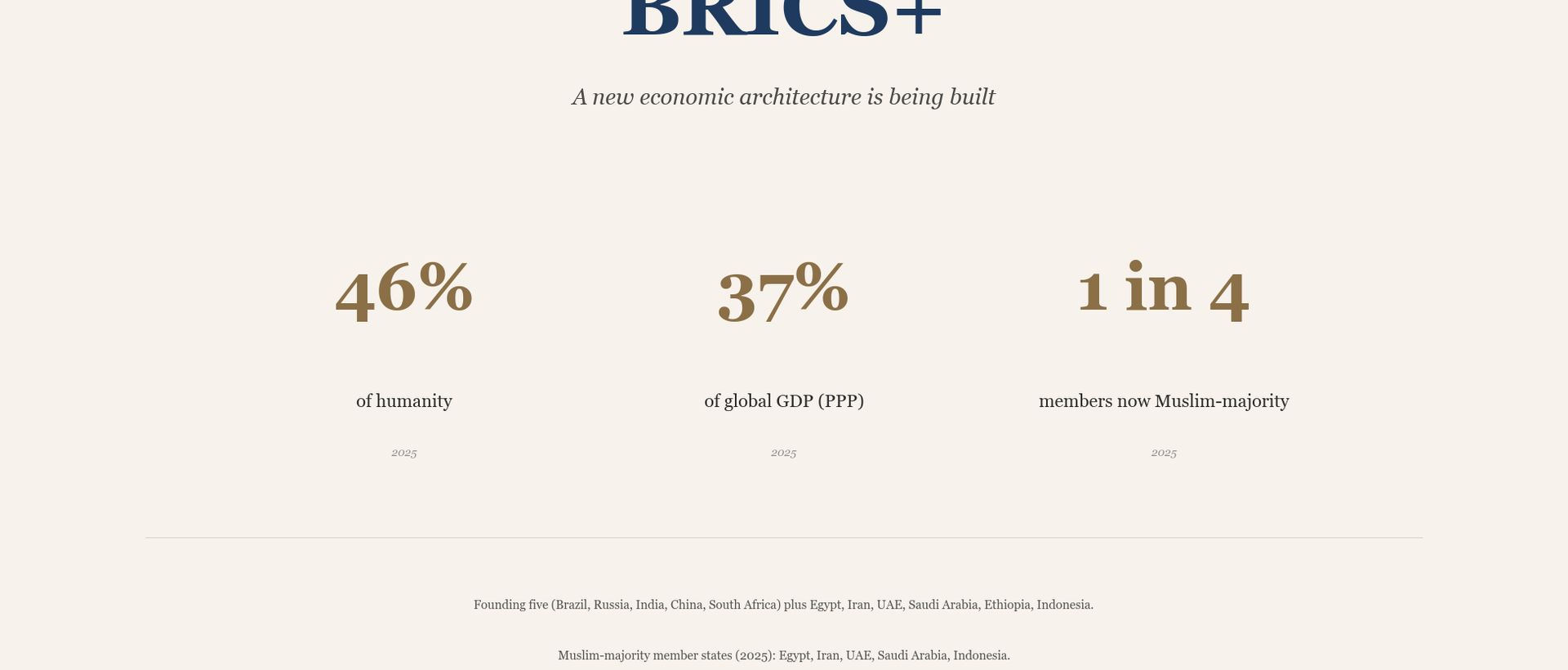
The group now represents more than 40% of the world's population and over 30% of global GDP. With energy giants like Saudi Arabia, Iran, and Russia, it controls vast resources. By promoting trade in local currencies and building new institutions, BRICS+ is directly undermining Western control.
For Muslim families in the UK, the technicalities may seem remote. But the consequences are close to home. A weaker Western system means more instability in Britain --- higher costs of living, shrinking opportunities, and an atmosphere of insecurity that often turns against minorities.
Britain's Position in a Changing World
Britain is deeply tied to the United States economically, militarily, and politically. The pound itself is bound to the dollar. When the US sneezes, Britain catches a cold. As BRICS+ strengthens, Western sanctions become less effective, the dollar gradually loses influence, and new trade routes bypass Europe. This leaves Britain more exposed and less competitive.
Already, we see the cracks: industries struggling with high energy costs, inflation eroding savings, and younger generations unable to afford homes. As the West's leverage declines, it cannot guarantee the prosperity its citizens once took for granted.
For Muslims in Britain, this means tighter systems, higher taxes, and an environment where resentment looks for easy targets. It is no coincidence that anti-immigrant rhetoric rises in times of economic stress.
Why This Matters for Muslim Families
The decline of Western dominance has direct implications.
- Rising costs: A weaker pound means imports --- from food to fuel
--- become more expensive. Families already struggling with bills will feel the squeeze.
- Job insecurity: Industries that once thrived on Western dominance
are losing ground. Manufacturing, finance, even tech are shifting eastward.
- Cultural backlash: When Western powers feel threatened, they
double down on identity politics. Muslims, with visible difference and global ties, are easy scapegoats.
This isn't speculation; it is history repeating itself. Declining powers have always turned inward and lashed out. Britain is no exception.
Hijrah as Rational Foresight
In this context, Hijrah becomes more than a spiritual idea. It becomes rational foresight. Muslim-majority countries like Turkey, Malaysia, and Indonesia are aligning more with BRICS+ economies. They benefit from energy partnerships, growing trade networks, and demographic advantages. For Muslim families, this translates into lower costs of living, expanding opportunities, and environments where Islam is not marginalised.
The step does not have to be immediate. A second home in these regions can provide exposure, security, and a foothold. Even partial relocation --- summers abroad, trial schooling, remote work --- creates resilience. Families anchored only in Britain are tied to a declining system. Families with options abroad are better placed to weather storms.
A Case Study: The Malik Family in Bradford
The Maliks run a small import-export business. For years, they relied on European supply chains. But rising costs and delays after Brexit hit hard. Watching the rise of BRICS+, they began exploring trade links with Turkey and Malaysia. Alongside, they purchased a modest apartment in Kuala Lumpur.
Now, their business taps into growing markets in Asia, their children spend part of the year immersed in a Muslim society, and they have diversified financially. They still live mainly in Bradford, but their horizon is no longer tied exclusively to Britain's fortunes. For them, BRICS+ is not just a news headline; it is a reminder that the world is shifting, and foresight pays.
Islamic Anchoring
Islam teaches us to see beyond immediate comfort. The Qur'an says: "Do they not travel through the land, and see what was the end of those before them?" (30:9). History shows that civilisations rise and fall. The West's dominance was never permanent. Muslims must think not only about today's conveniences but about tomorrow's realities.
The Bigger Picture for Children
Perhaps the most important point is what this means for the next generation. Children raised in Britain today are growing up in a society under pressure. Economic decline translates into cultural insecurity. That insecurity often expresses itself in hostility to Islam. By contrast, children who spend time in BRICS-aligned Muslim countries grow up with different confidence. They see Islam in public life, not hidden. They see Muslims shaping the future, not defending themselves in decline.
Conclusion
BRICS+ is not an abstract bloc. It is a sign of a shifting world order. For Muslim families in Britain, it means that the system we rely on is weakening, and with that weakness comes instability and hostility.
Hijrah --- whether through full relocation or the step of a second home --- is a rational response. It is about positioning our families not on the margins of a fading power, but within the heart of a global Ummah that is finding new strength.
Safeguarding deen requires foresight. In a world where the West is no longer dominant, the question is not whether change will come, but whether we are prepared for it.
Next Step: For a deeper look at what these global shifts mean for your household finances, read [Dollar Weaponisation and Family Finance](../article/dollar-weaponisation-and-family-finance) and [Energy Wars](../article/energy-wars-how-global-power-struggles-affect-your-bills).